Georgia Texas 2019 Please Dont Speak Again
Youth Confinement: The Whole Pie 2019 Tweet this
By Wendy Sawyer
Press Release
December xix, 2019
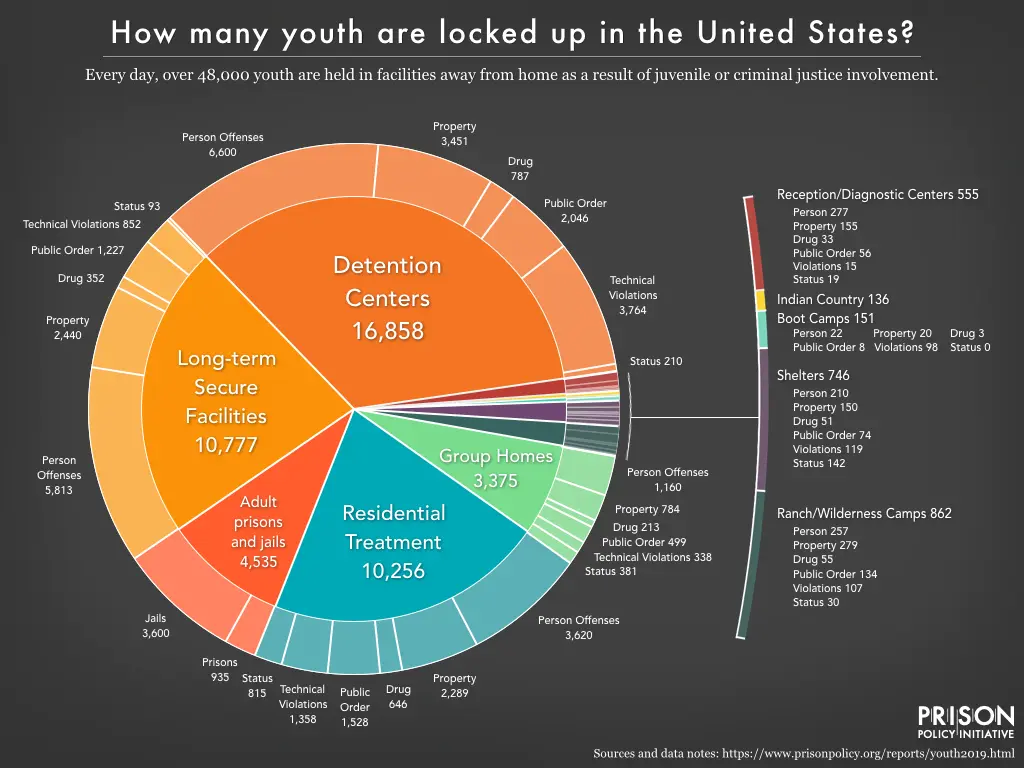
On any given day, over 48,000 youth in the United States are bars in facilities away from domicile equally a result of juvenile justice or criminal justice involvement. Most are held in restrictive, correctional-manner facilities, and thousands are held without even having had a trial. Simply even these high figures represent astonishing progress: Since 2000, the number of youth in confinement has fallen by threescore%, a trend that shows no sign of slowing down.
What explains these remarkable changes? How are the juvenile justice and adult criminal justice systems different, and how are they similar? Perhaps most importantly, tin those working to reduce the number of adults behind bars larn any lessons from the progress made in reducing youth solitude?
This report answers these questions, starting time with a snapshot of how many justice-involved youth are confined, where they are held, under what atmospheric condition, and for what offenses. It offers a starting point for people new to the effect to consider the means that the issues of the criminal justice system are mirrored in the juvenile organisation: racial disparities, castigating conditions, pretrial detention, and overcriminalization. While acknowledging the philosophical, cultural, and procedural differences betwixt the adult and juvenile justice systems,1 the report highlights these bug as areas ripe for reform for youth too as adults.
This updated and expanded version of our original 2018 study also examines the dramatic reduction in the bars youth population, and offers insights and recommendations for advocates and policymakers working to shrink the developed criminal justice system.
Demographics and disparities amongst confined youth
Mostly speaking, state juvenile justice systems handle cases involving defendants under the age of xviii.ii (This is not a hard-and-fast rule, however; every state makes exceptions for younger people to be prosecuted as adults in some situations or for certain offenses.3) Of the 43,000 youth in juvenile facilities, more than than 2-thirds (69%) are 16 or older. Troublingly, more than than 500 confined children are no more than 12 years old.4
Black and American Indian youth are overrepresented in juvenile facilities, while white youth are underrepresented. These racial disparitiesv are peculiarly pronounced amid both Black boys and Black girls, and while American Indian girls make upward a small part of the confined population, they are extremely overrepresented relative to their share of the total youth population. While xiv% of all youth under 18 in the U.S. are Black, 42% of boys and 35% of girls in juvenile facilities are Black. And even excluding youth held in Indian country facilities, American Indians make up 3% of girls and 1.5% of boys in juvenile facilities, despite comprising less than ane% of all youth nationally.6
Racial disparities are also axiomatic in decisions to transfer youth from juvenile to adult court. In 2017, Black youth made upwards 35% of delinquency cases, simply over one-half (54%) of youth judicially transferred from juvenile court to adult court. Meanwhile, white youth accounted for 44% of all delinquency cases, but made upwardly simply 31% of judicial transfers to adult courtroom. And although the total number of youth judicially transferred in 2017 was less than half what it was in 2005, the racial disproportionality among these transfers has actually increased over time. Reports likewise prove that in California, prosecutors send Hispanic youth to adult courtroom via "direct file" at 3.4 times the rate of white youth, and that American Indian youth are 1.8 times more probable than white youth to receive an adult prison judgement.
Nearly youth are held in correctional-style facilities
Justice-involved youth are held in a number of dissimilar types of facilities. (Encounter "types of facilities" sidebar.) Some facilities look a lot like prisons, some are prisons, and others offering youth more liberty and services. For many youth, "residential placement" in juvenile facilities is virtually indistinguishable from incarceration.
Well-nigh youth in juvenile facilities10 experience distinctly carceral conditions, in facilities that are:
- Locked: 92% of youth in juvenile facilities are in locked facilities. According to a 2018 report, 52% of long-term secure facilities, 44% of detention centers, and 43% of reception/diagnostic centers also use "mechanical restraints" like handcuffs, leg cuffs, restraining chairs, strait jackets, etc. Xl per centum of long-term secure facilities and detention centers isolate youth in locked rooms for iv hours or more.
- Large: 81% are held in facilities with more than 21 "residents." Over half (51%) are in facilities with more than 51 residents. More than 10% are held in facilities that hold more than 200 youth.
- Long-term: Ii-thirds (66%) of youth are held for longer than a month; virtually a quarter (24%) are held over half-dozen months; well-nigh iv,000 youths (8%) are held for over a year.xi

Two out of every three bars youth are held in the most restrictive facilities — in the juvenile justice system's versions of jails and prisons, or in actual adult jails and prisons. 4,535 confined youth — nearly 1 in x — are incarcerated in adult jails and prisons, where they face greater safe risks and fewer age-appropriate services are available to them.12 xiii At to the lowest degree another 28,190 are held in the three types of juvenile facilities that are best described every bit correctional facilities: (1) detention centers, (2) long-term secure facilities, and (three) reception/diagnostic centers.14 99.7% of all youth in these three types of correctional facilities are "restricted by locked doors, gates, or fences"15 rather than staff-secured, and 60% are in large facilities designed for more than than l youth.
The largest share of confined youth are held in detention centers. These are the functional equivalents of jails in the adult criminal justice system. Like jails, they are typically operated by local authorities, and are used for the temporary restrictive custody of defendants awaiting a hearing or disposition (judgement). Over 60% of youth in detention centers fall into those 2 categories.16
But how many of the 17,000 children and teenagers in juvenile detention centers should actually be there? According to federal guidance, "...the purpose of juvenile detention is to confine but those youth who are serious, violent, or chronic offenders... pending legal action. Based on these criteria, [it] is not considered appropriate for status offenders and youth that commit technical violations of probation." Nonetheless near 4,000 youth are held in detention centers for these same low-level offenses. And nearly 2,000 more than take been sentenced to serve time there for other offenses, even though detention centers offer fewer programs and services than other facilities. In fact, "National leaders in juvenile justice... support the prohibition of juvenile detention as a dispositional selection."
The most common placement for committed (sentenced) youth is in long-term secure facilities, where the conditions of solitude invite comparisons to prisons. Frequently chosen "training schools," these are typically the largest and oldest facilities, sometimes holding hundreds of youths behind razor wire fences, where they may be subjected to pepper spray, mechanical restraints, and solitary confinement.17
The third correctional-style facility type, reception/diagnostic centers, are often located adjacent to long-term facilities; here, staff evaluate youth committed by the courts and assign them to correctional facilities. Similar detention centers, these are meant to be transitional placements, yet over half of the youth they concord are there longer than xc days. More than 1 in 7 youth in these "temporary" facilities is held in that location for over a yr.
Outside of these correctional-mode facilities, some other fifteen,400 youth are in more "residential" manner facilities that are typically less restrictive, just vary tremendously, ranging from secure, armed forces-style kick camps to group homes where youth may leave to attend school or get to work. About of these youth (78%) are still in locked facilities rather than staff-secured, and weather condition in some of these facilities are reportedly worse than prisons. Almost 9 out of 10 youth in these more "residential" facilities are in residential treatment facilities or group homes. Less frequently, youth are held in ranch or wilderness camps, shelters, or kick camps.
Some facility types are much worse than others
The blazon of facility where a child is confined can affect their wellness, safe, access to services, and outcomes upon reentry. Developed prisons and jails are unquestionably the worst places for youth. They are not designed to provide age-appropriate services for children and teens, and according to the Campaign for Youth Justice, youth in adult facilities may exist placed in lonely confinement to comply with the PREA condom standard of "sight and sound" separation from incarcerated adults. Youth in developed facilities are also 5 times more than likely to commit suicide than those in juvenile facilities.
Correctional-mode juvenile detention centers and long-term secure "youth prisons" are often very harmful environments, too. In the Survey of Youth in Residential Placement, more youth in detention and corrections programs reported sexual victimization, fright of attack, lonely confinement, strip searches, utilize of restraints, unnecessary utilize of strength, and poor relations with staff. Correctional-style facilities also tend to be larger, and youth in larger facilities (with more than 25 beds) study higher rates of sexual victimization. Youth in detention centers, in item, report receiving the fewest pedagogy services, such as special education, GED training, and job grooming. These youth are also most likely to study difficulty sleeping because of light, indicating that, like many adult facilities, the lights are left on even at night. For a youth population that typically come with a history of trauma and victimization, confinement under any weather leads to worse outcomes, but the punitive correctional-way facilities are specially dehumanizing.
Locked up before they're even tried

To exist sure, many justice-involved youth are found guilty of serious offenses and could conceivably pose a risk in the community. Merely pretrial detention is surprisingly common; judges choose to detain youth in over a quarter (26%) of delinquency cases, resulting in a disturbing number of youth in juvenile facilities who are not even serving a sentence.
More than 9,500 youth in juvenile facilities — or one in 5 — haven't even been found guilty or delinquent, and are locked upwardly before a hearing (awaiting trial). Another 6,100 are detained pending disposition (sentencing) or placement. Virtually detained youth are held in detention centers, but nearly 1,000 are locked in long-term secure facilities — essentially prisons — without even having been committed. Of those, less than half are accused of violent offenses.xviii
Even if pretrial detention might be justified in some serious cases, over 3,200 youth are detained for technical violations of probation or parole, or for condition offenses, which are "behaviors that are not law violations for adults."xix
Once over again mirroring the developed criminal justice system, youth pretrial detention is marred by racial disparity. Less than 21% of white youth with delinquency cases are detained, compared to 32% of Hispanic youth, 30% of Black youth, 26% of American Indian youth, and 25% of Asian, Native Hawaiian, or Pacific Islander youth. Time held pretrial isolates youth from their families and communities and exposes them to the gamble of victimization while detained. Yet in 2017, over twoscore% of detained youth had been held for longer than 30 days, and virtually 500 had already been detained for over a year.
Finally, youth that are transferred to the adult system can be subject to pretrial detention if their family or friends cannot afford bail. Equally a issue, they may be jailed in adult facilities for weeks or months without even being convicted.
Incarcerated for small offenses

Far from locking up youth only as a last resort, the juvenile justice arrangement confines large numbers of children and teenagers for the everyman-level offenses. For almost i in 5 youth in juvenile facilities, the almost serious accuse levelled confronting them is a technical violation (15%) or a condition criminal offence (4%).20 These are behaviors that would not warrant confinement except for their status as probationers or equally minors.
These are youth who are locked up for not reporting to their probation officers, for failing to complete community service or follow through with referrals — or for truancy, running away, violating curfew, or being otherwise "ungovernable."21 Such pocket-size offenses can result in long stays or placement in the nigh restrictive environments. Most one-half of youths held for status offenses are in that location for over ninety days, and almost a quarter are held in the restrictive, correctional-manner types of juvenile facilities.
Progress toward decarceration of the juvenile justice organisation
The fact that nearly 50,000 youth are confined today — frequently for low-level offenses or earlier they've had a hearing — signals that reforms are desperately needed in the juvenile justice system. Confinement remains a punishing, and oft traumatizing, feel for youth who typically already have a history of trauma and victimization. Without discounting the many ongoing problems discussed in this study, however, there is another, more positive story almost juvenile justice reform.
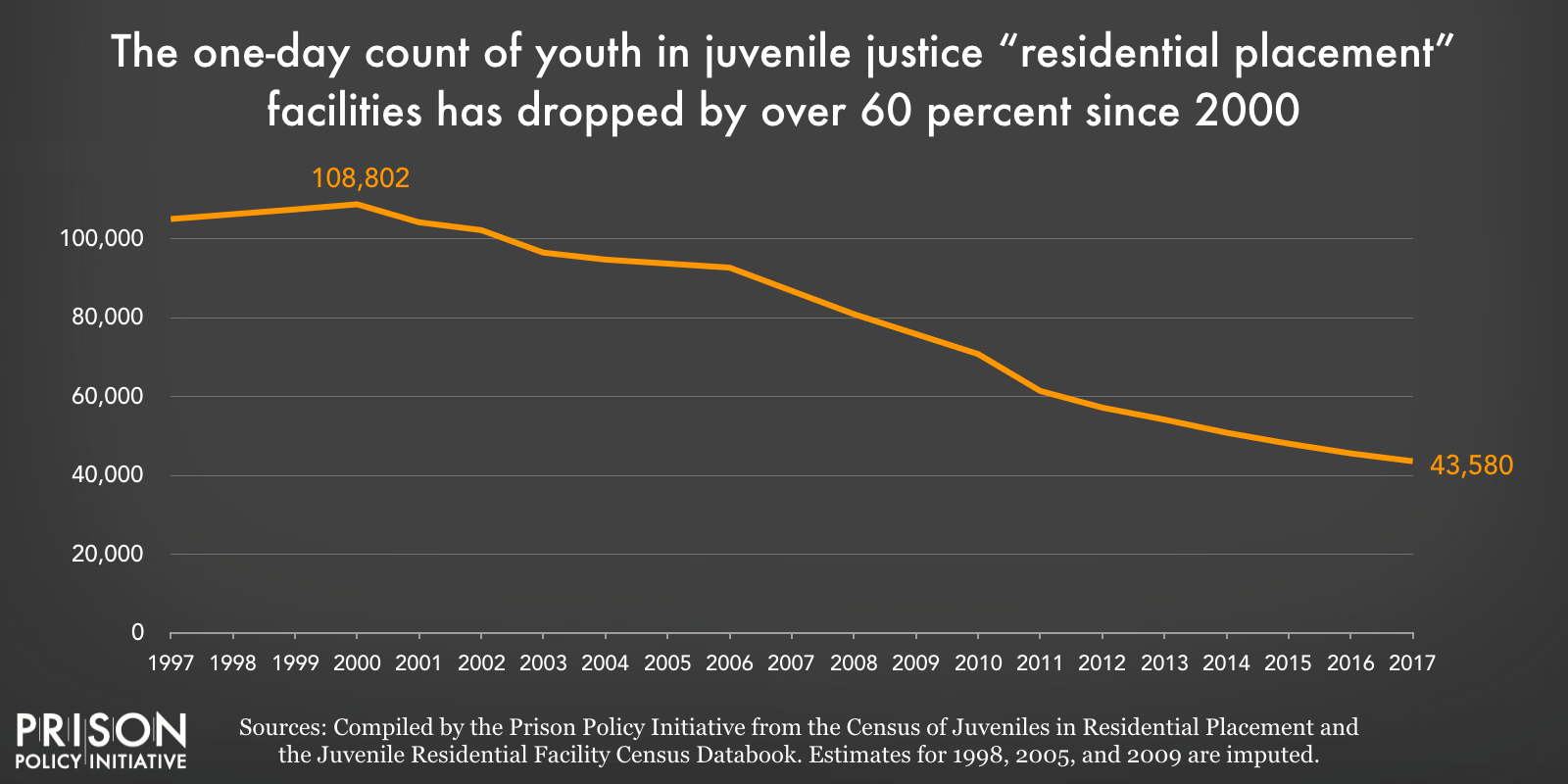 The number of youth confined in juvenile facilities has dropped by over 60% since its tiptop in 2000, while the developed incarcerated population (which peaked after) has fallen just 10% since 2007. The number of youth held in adult prisons and jails has also dropped dramatically (meet that nautical chart here), although nearly i in ten bars youth are however held in adult facilities.
Policymakers focused on the juvenile justice system accept responded far more rationally to the falling crime rate and to the mounting evidence of "what works" compared to those working on the developed criminal justice system. At a fourth dimension when a 50% reduction in the adult prison and jail population over 10 or 15 years still seems radical to many, the juvenile system has already cut the number of bars youth by lx% since 2000, and continues to decarcerate at a rate of roughly v% year over year. The number of youth in adult prisons and jails has also dropped past over lx% since 2000. And over the same menstruum, nearly 1,300 juvenile facilities have closed, including over ii-thirds of the largest facilities. From an adult criminal justice reform perspective, this is enviable progress.
The progress toward decarceration in the juvenile system can't be attributed to any unmarried change; rather, historical factors, ongoing research, and dogged advocacy efforts all played important roles. Juvenile crime rates dropped. Some of the about egregious conditions of confinement were widely publicized, jolting policymakers to activeness. Adolescent brain inquiry made it impossible to deem youth fully culpable and incapable of alter. Show piled upwardly showing that solitude leads to worse outcomes.
Much of the progress tin be attributed to the work of advocates who pushed for federal legislation to protect bars youth (especially PREA and the JJDPA), and for state laws that "raised the historic period" of juvenile court jurisdiction, discouraged transfers to adult courts, and allowed for more than individualized sentencing. Many of these strategies have parallels in the criminal justice reform motility, such as repealing mandatory minimum sentences, while others, similar "heighten the age," don't really apply. But juvenile justice reform advocates have also had success with strategies to both improve atmospheric condition and reduce the use of solitude that the broader criminal justice reform movement can adopt.
An inexhaustive list of successful reform strategies that take been used to decarcerate the juvenile justice system, and that could be be adjusted and applied to the developed criminal justice system, includes:
- Endmost and repurposing prisons and detention centers, and redirecting resource to serve people in their communities: Missouri airtight its correctional-style "grooming schools" 30 years ago, replacing them with a well-staffed network of smaller, dorm-similar "treatment centers" focused on rehabilitative programming. This has become known as the "Missouri Model" of juvenile justice reform. While there take been no comparable statewide initiatives to close adult prisons, the Vera Institute of Justice and the Prison Constabulary Office accept taken officials from diverse states to visit prisons in Northern Europe to come across for themselves how a more humane correctional system can enhance rehabilitation efforts and reduce the harms of incarceration.
- Developing programs to safely serve people charged with tearing offenses in their homes and communities: While efforts to reduce adult prison and jail populations generally exclude people charged with trigger-happy offenses, juvenile justice experts have pushed for "no reject policies," recognizing that home- and customs-based interventions are more than constructive than incarceration for youth charged with all kinds of offenses. The field has developed testify-based programs that reduce violence and delinquent, criminal, and aggressive behavior among youth with "elevated risk levels" — without confinement. Criminal justice reform advocates have begun to recognize the need for new approaches to violence, and can expect to these programs every bit models for supportive, non-carceral alternatives.
- Changing laws to make certain offenses "non-jailable": In the juvenile justice context, states like Utah and Massachusetts have removed status offenses from juvenile court jurisdiction, and federal legislation (the JJDPA) mandates the deinstitutionalization of condition offenders. (The JJDPA makes an exception for youth who have violated a valid courtroom order (the "VCO exception"), but several states take passed laws to annul that exception.) A number of states, including California, Hawaii, Kentucky, Georgia, Florida, Mississippi, and Texas, take also ended commitment to secure juvenile facilities for low-level or nonviolent offenses.
- Issuing ceremonious citations in lieu of arrest to divert people away from courtroom intervention: Delaware's Juvenile Civil Citation plan and Florida'due south Judicial Circuit Civil Citation and Like Prearrest Diversion program are examples of two statewide efforts to offer youth accused of misdemeanors alternative, customs-based sanctions, such every bit family counseling and treatment for substance abuse or mental health, and restorative measures such as customs service, apology letters, community impact statements, restitution, etc. While cite-and-release programs are mutual in the developed criminal justice system, they generally serve to forbid jail detention, not prosecution. These youth programs, even so, allow youth to avert prosecution and its consequences altogether. From November 2018 to Oct 2019, near ten,000 (or 62%) of eligible youth in Florida avoided formal prosecution through pre-arrest diversion.
- Capping sentences to reduce time under correctional supervision: Kentucky, Utah, and Tennessee have set limits on the amount of time youth can be in out of home placement, on probation, and/or under court supervision, and Georgia reduced maximum sentences for sure felonies from v years to 18 months. Such limits are rare in the developed system, where, for instance, indeterminate sentences are the norm and long probation sentences often lead to further supervision or incarceration — but Florida's 2 yr cap on probation sentences (Fla. Stat. S 948.04) stands out as one case of this strategy applied in the adult system.
- Shifting funding to develop and aggrandize customs-based alternatives to incarceration: Merely concluding year, Tennessee committed $4.5 million per twelvemonth to aggrandize community-based services and to provide juvenile courts with more handling options. Georgia, which created a grant program in 2013 for counties that reduce the number of committed youth, has shifted $30 million to customs-based alternatives and closed several juvenile facilities. This "justice reinvestment" model has been implemented in many states' adult systems every bit well, simply these examples show the value in focusing on "front" reforms to reduce overall incarceration.
- Recognizing and addressing the bear on of trauma on justice-involved populations: An estimated 90% of justice-involved youth have experienced serious trauma in their lifetime. Understanding the touch of trauma on cognitive development and behavior, policymakers and practitioners have increasingly called for trauma-informed intendance — not punishment — for justice-involved youth. Nonetheless although incarcerated adults also typically have a history of traumatic victimization, recognition of by trauma has yet to inform sentencing and treatment for most justice-involved adults. Making policymakers and the public more aware of the link betwixt victimization and justice system interest could assistance shift political winds to have a less punitive, and more than supportive, arroyo.
Conclusions
This "big moving-picture show" study not only reveals ways in which the juvenile justice system must improve, only also offers lessons from progress that has already been fabricated. States have reduced the number of youth in confinement by more than than half without seeing an increase in criminal offence — a victory that should embolden policymakers to reduce incarceration further, for youth and adults alike.
By our most conservative estimates, states could release at least thirteen,500 more youth today without smashing run a risk to public safe. These include almost i,700 youth held for status offenses, i,800 held for drug offenses other than trafficking, over 3,300 held for public club offenses not involving weapons, and 6,700 held for technical violations. 22 States should likewise look more closely at youth detained pretrial. Beyond youth detained for those low-level offense categories, over 7,00023 others are held earlier they've been found guilty or delinquent; many, if not all, of these youth would be meliorate served in the community.
Across releasing and resentencing youth, states should remove all youth from developed jails and prisons, close large juvenile facilities, and invest in non-residential customs-based programs.24 Legislators should continue to update laws to reverberate our current understanding of encephalon development and criminal behavior over the life course, such every bit raising the historic period of juvenile court jurisdiction and ending the prosecution of youth equally adults.25
But lawmakers who support reducing incarceration among youth should too consider supporting radical reforms to the adult criminal justice arrangement. Like youth solitude,26 adult incarceration inflicts lasting physical, mental, and economic harm on individuals and families. And falling rates of both youth criminal offence and youth incarceration provide prove that bold reforms — such as making more than offenses "not-jailable" and expanding community-based alternatives to incarceration — could be applied to the adult organisation while maintaining public prophylactic.
Like the criminal justice and juvenile justice systems themselves, the efforts to contrary mass incarceration for adults and to deinstitutionalize justice-involved youth have remained curiously distinct. Only the two systems accept more than problems — and potentially, more solutions — in common than one might think. The momentum of decarceration in the juvenile justice system must go along, and it should inspire bolder reforms in the criminal justice system as well.
A note virtually language used in this report
Many terms related to the juvenile justice system are contentious. We have elected to refer to people younger than 18 as "youth(s)" and avoid the stigmatizing term "juvenile" except where it is a term of art ("juvenile justice"), a legal distinction ("tried equally juveniles"), or the nigh widely used term ("juvenile facilities"). We also chose to use the terms "confinement" and "incarceration" to depict residential placement, because we concluded that these were appropriate terms for the conditions nether which most youth are held (although we recognize that facilities vary in terms of restrictiveness). Finally, the racial and ethnic terms used to describe the demographic characteristics of bars youth (e.k. "American Indian") reverberate the language used in the data sources.
Finally, because this written report is directed at people more familiar with the criminal justice system than the juvenile justice system, we occasionally made some linguistic communication choices to make the transition to juvenile justice processes easier. For example, nosotros employ the familiar term "pretrial detention" to refer to the detention of youths awaiting adjudicatory hearings, which are non generally called trials.
Read the language note
Read about the data
In an effort to capture the total scope of youth confinement, this written report aggregates information on youth held in both juvenile and adult facilities. Unfortunately, the juvenile and adult justice organisation data are non completely uniform, both in terms of vocabulary and the measures made available.
Because we anticipate this written report will serve as an introduction to juvenile justice problems for many already familiar with the developed criminal justice system, we have attempted to bridge the language gap between these 2 systems wherever possible, by providing criminal justice system "translations." Information technology should exist noted, however, that the differences between juvenile and criminal justice system terminology reverberate real (if subtle) philosophical and procedural differences between the two parallel systems.
The Function of Juvenile Justice and Delinquency Prevention (OJJDP) provides piece of cake access to detailed, descriptive data assay of juvenile residential placements and the youths held in them. In contrast, the Bureau of Justice Statistics (BJS) provides very limited information on youth held in other settings. For youths in adult prisons, all that is readily accessible in government reports is their number past sex and past jurisdictional bureau (land or federal). In almanac regime reports on jails, youths are only differentiated past whether they are held as adults or juveniles. Slightly more detailed information is reported on youths in Indian country facilities, only the measures reported are not wholly consistent with the juvenile justice survey, and facility-level analysis is necessary to separate youths from adults for most measures.
Despite these challenges, this report brings together the most recent data available on the number of youths held in various types of facilities and the most serious offense for which they are charged, adjudicated, or convicted. The only youth included in this analysis are involved in the juvenile or criminal justice process. Youth who are put in out-of-home placements because their parents or guardian are unwilling or unable to care for them (i.e. dependency cases) are not included in this analysis. The approximately 5,000 children in the custody of the Office of Refugee Resettlement (ORR) for clearing reasons are also non included, since they are not held there due to juvenile or criminal justice involvement. While these diverse systems that keep children in out-of-habitation arrangements are interrelated, an analysis of the impact of immigration or child welfare policies on youth justice system involvement is beyond the scope of this report.
Data sources:
-
Juvenile facilities: Most of the information in this report comes from the Census of Juveniles in Residential Placement (CJRP) in 2017. The Role of Juvenile Justice and Delinquency Prevention (OJJDP) reports i-day counts of youth under 21 in "juvenile residential facilities for court-involved offenders" on the Easy Access to the Demography of Juveniles in Residential Placement (EZACJRP) website. It includes facility information including facility self-classification (type), size, operation (local, land, or private), and whether information technology is locked or staff secure. It also includes information on the youth held in these facilities, including law-breaking type, placement status, days since access, sex activity, race, and historic period. The analysis of juvenile facility characteristics and demographics of youth in juvenile facilities are based on cross tabulation using the "National Crosstabs" tool.
The Juvenile Residential Facility Census Databook: 2000-2016 (JRFC) was used to supplement the CJRP information, and provided more information near the number, size, and blazon of juvenile facilities over time.
- Developed jails: The Bureau of Justice Statistics (BJS) reports the number of people age 17 or younger held in local jails with a breakdown of how many are held as adults versus juveniles in Table iii of Jail Inmates in 2017.
- Adult prisons: BJS reports the yearend count of "prisoners age 17 or younger under jurisdiction of federal correctional authorities or the custody of state correctional regime" in Tabular array 11 of Prisoners in 2017. (The BJS Corrections Statistical Analysis Tool (CSAT) — Prisoners too reports these counts from 2000-2016.) Prisoners in 2017 states that "the Federal Bureau of Prisons holds prisoners age 17 or younger in individual contract facilities," but it is unclear which facilities really hold these youth. Nosotros included these facilties in our count of adult prisons, but it is possible that the 42 youth nether Federal Bureau of Prisons (BOP) jurisdiction in 2017 may have been captured in the Demography of Juveniles in Residential Placement information, and therefore it's possible they were double-counted.
- Indian country: BJS reports the number of youths historic period 17 and younger in Indian country jails past facility and sexual practice in Appendix tabular array 4 of Jails in Indian Country, 2016. Although BJS provides a national judge using data imputed for nonresponse in the aforementioned table (estimating 110 males and 60 females), nosotros used the reported numbers (84 males and 52 females) because they stand for to the more than detailed facility-level information. Using the breakdown by facility, we were able to determine how many youth are held in facilities that only agree youth versus those in combined developed/juvenile facilities. These youth are included in our total population of youth confinement, only excluded from analysis of the characteristics of juvenile facilities and youth in residential placement, which is based on the Census of Juveniles in Residential Placement (CJRP) information. BJS reports some details that are similar to CJRP data, simply exercise non lucifer them enough to the two combine datasets (for example, criminal offence categories are different, completely excluding technical violations and status offenses).
To compare racial and ethnic representation in juvenile facilities to the full general population of all youths (17 or younger) in the U.Southward., we used general population data from the 2018 "Child population past race and age group" table by the Kids Count Information Center (The Annie E. Casey Foundation).
The judge of the number of youth confined for low-level offenses who could exist considered for release (in the Conclusions section) includes xiii,506 held in juvenile facilities on a given day in 2017. 1,690 of these youth were held for condition offenses, 1,820 for "other drug offenses," iii,345 for "other public order offenses," and 6,651 for technical violations. Additionally (although the criminal offence categories are inconsistent with those in the CJRP), Indian country facilities holding only youth age 17 or younger held lx youth for seemingly depression-level offenses: sixteen for public intoxication, 2 for DWI/DUI, and 42 for "other unspecified" (this dataset does not include technical violations or condition offenses as offense categories). These youth in Indian state facilities could as well be considered for release, but they are non included in this estimate. We did not include youth held in adult prisons and jails in this estimate because crime types were non reported for them.
The estimate of the number of youth detained pretrial who could be considered for release includes 6,995 youth detained in juvenile facilities and 56 unconvicted youth in Indian country facilities.
At the time of the survey, six,995 youth in juvenile facilities were detained pending either adjudication, criminal court hearing, or transfer hearing (essentially, they were being held before being found runaway or guilty). This effigy does not include the 2,558 youth detained for technical violations, status offenses, "other drug offenses," or "other public order offenses" while they awaited these hearings, because nosotros already included them in the roughly xiii,500 youth held for low-level offenses that could be released.
Jails in Indian Country, 2016 reports at least 56 unconvicted youth in facilities holding simply people age 17 or younger. This may slightly underreport the unconvicted population, because the conviction status of youth in combined developed and juvenile Indian country facilities was non reported separately from the adults, and one juvenile facility did not report conviction status.
Youths held in adult prisons and jails were not included in this estimate considering conviction status was not reported for these youth. However Jail Inmates in 2017 notes that jails "may concur juveniles before or after they are adjudicated."
Read the entire methodology
Acknowledgements
This written report was made possible by the generous contributions of individuals across the country who support justice reform. Individual donors requite our organization the resources and flexibility to rapidly turn our insights into new move resources.
The author would like to give thanks her Prison Policy Initiative colleagues for their feedback and assistance in the drafting of this report, too as reviewers from the Youth First Initiative and the Campaign for Youth Justice. Elydah Joyce helped pattern the chief graphic, while Bob Machuga created the cover. Nosotros likewise acknowledge all of the donors, researchers, programmers and designers who helped the Prison Policy Initiative develop the Mass Incarceration: The Whole Pie series of reports.
About the Prison Policy Initiative
The non-profit non-partisan Prison Policy Initiative was founded in 2001 to expose the broader harm of mass criminalization and spark advocacy campaigns to create a more merely society. The organization is most well-known for its big-picture publication Mass Incarceration: The Whole Pie that helps the public more fully engage in criminal justice reform. This study builds upon that piece of work and the analysis of women'south incarceration, Women's Mass Incarceration: The Whole Pie.
About the author
Wendy Sawyer is the Research Director at the Prison house Policy Initiative. She is the co-author, with Peter Wagner, of Mass Incarceration: The Whole Pie and States of Incarceration: The Global Context 2018. She is also the author of the original 2018 Youth Confinement: The Whole Pie report, every bit well as The Gender Divide: Tracking women's country prison growth and Punishing Poverty: The loftier cost of probation fees in Massachusetts.
Source: https://www.prisonpolicy.org/reports/youth2019.html
0 Response to "Georgia Texas 2019 Please Dont Speak Again"
Postar um comentário